

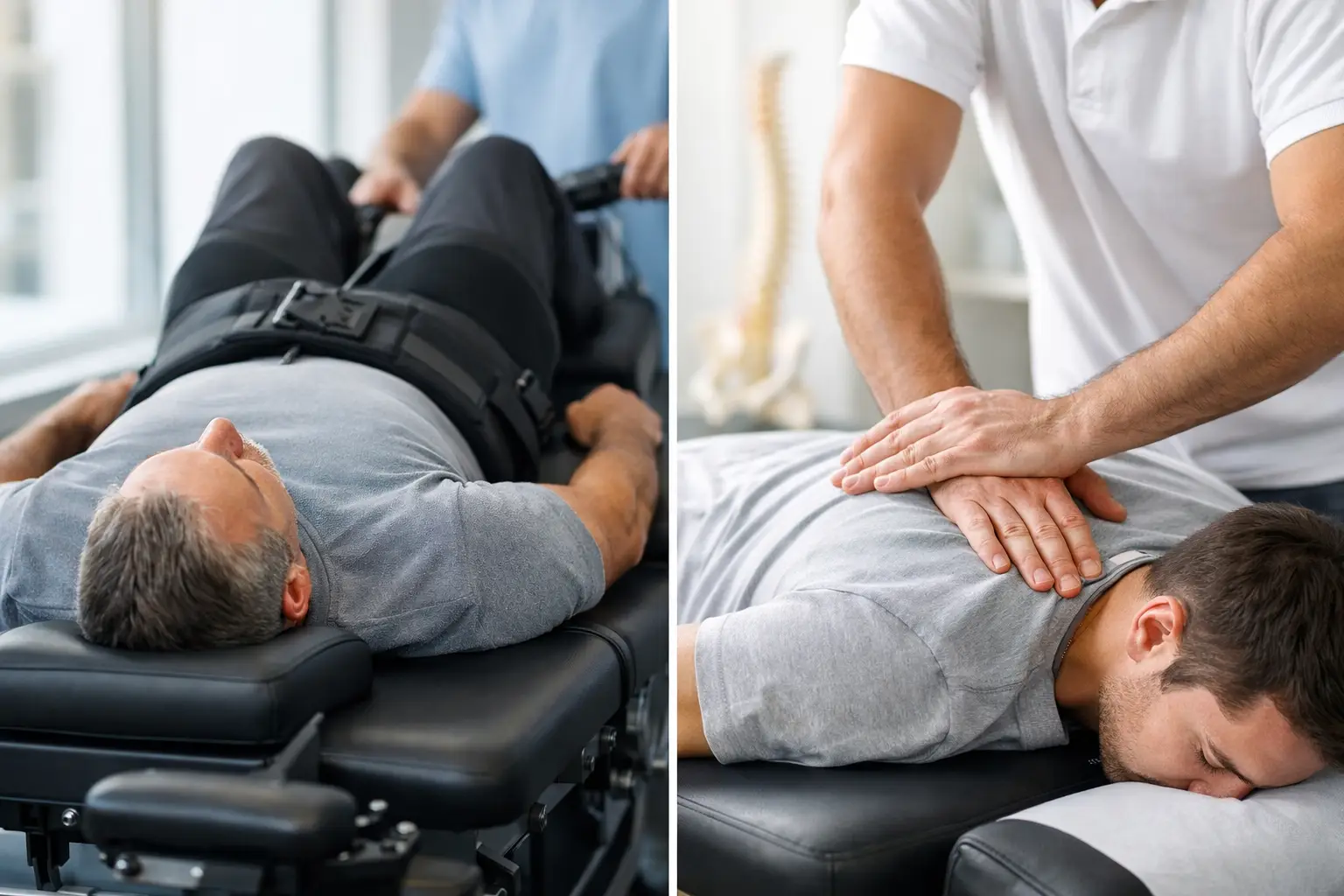
A stiff lower back after long hours at a desk can feel very different from sharp leg pain that starts in the back and travels downward. That difference matters when considering spinal decompression versus adjustments. Both approaches may be part of conservative chiropractic care, but they work differently and are not interchangeable.
The best choice is not the treatment that sounds most advanced or produces the quickest temporary change. It is the one that fits your symptoms, health history, movement patterns, comfort level, and goals. For some people, a gentle adjustment is a helpful part of restoring mobility. For others, carefully applied decompression may be considered alongside movement, posture support, and other conservative care.
Spinal Decompression Versus Adjustments: The Core Difference
Spinal adjustments are hands-on chiropractic techniques intended to improve joint motion and address areas of restricted movement in the spine or other joints. Depending on the technique and your needs, an adjustment may involve a quick, controlled movement or a gentler low-force approach. The familiar popping sound can happen during some adjustments, but it is not the goal and does not determine whether care was effective.
Spinal decompression usually refers to non-surgical traction therapy. It uses controlled, gradual pulling and releasing forces to gently distract the spine. The aim is to reduce compressive loading for a period of time and support more comfortable movement. It is commonly discussed when a person has symptoms that may be associated with disc irritation, such as low back pain with leg symptoms, although a thorough evaluation is needed before assuming a disc is the source.
In simple terms, adjustments focus on joint movement and mechanics. Decompression focuses on a controlled traction force along the spine. A care plan may include one, neither, or occasionally both, depending on what is appropriate for the individual.
When an Adjustment May Be the Better Fit
An adjustment may be considered when stiffness, limited range of motion, muscle guarding, or posture-related strain is affecting your ability to move comfortably. Working professionals who spend hours at a computer, parents who frequently lift children, and active adults recovering from an awkward workout often notice that certain parts of the spine or hips simply do not move as freely as they used to.
Gentle chiropractic adjustments can be part of a plan to address those restrictions. The purpose is not to force the body into a perfect position. It is to support healthier movement, reduce mechanical stress, and help you return to the activities that matter to you.
The experience should be tailored to your comfort. Some patients prefer traditional manual adjustments, while others feel better with low-force methods. A thoughtful chiropractor will consider your age, bone health, prior surgeries, current symptoms, and preferences before recommending a technique.
An adjustment alone is rarely the entire answer. Lasting improvement often depends on the habits surrounding treatment: how you sit, lift, sleep, train, recover, and manage stress. Postural analysis and practical movement guidance can help identify patterns that keep bringing discomfort back.
When Spinal Decompression May Be Considered
Non-surgical spinal decompression may be considered for certain people with persistent low back or neck discomfort, particularly when symptoms are aggravated by compression or involve radiating sensations into an arm or leg. During treatment, you are positioned on a specialized table or traction device while the spine is gently stretched in a controlled pattern.
Some patients describe the experience as a gradual release rather than an intense treatment. Still, decompression is not appropriate for every type of back pain, and it should never be selected simply because an MRI mentions a bulging or degenerated disc. Imaging findings are common, especially with age, and do not always explain how someone feels or moves.
A clinician should look at the full picture: when symptoms began, what movements change them, whether numbness or weakness is present, what previous care has helped, and whether there are medical reasons to avoid traction. Conditions such as fractures, significant osteoporosis, certain spinal instability concerns, infection, cancer affecting the spine, or some postsurgical situations may require a different approach or medical clearance.
Decompression also is not a replacement for urgent medical evaluation. New or worsening muscle weakness, loss of bowel or bladder control, numbness in the groin area, fever with severe back pain, or pain after major trauma need prompt medical attention.
The Trade-Offs to Consider
Neither option should be presented as a one-size-fits-all cure. Adjustments are often brief and can be useful for mobility concerns, but they may not be the right choice when a patient is experiencing acute irritation, has specific health risks, or simply does not feel comfortable with that style of care.
Decompression sessions are typically longer and may involve a course of care, which can require more time and cost. Some people may feel temporary soreness or symptom changes after either treatment. Your provider should explain what to expect, how progress will be measured, and when the plan should be adjusted.
The right question is not, “Which treatment is stronger?” A more helpful question is, “What is contributing to my discomfort, and which conservative tools best support my recovery?” Sometimes the answer is gentle spinal care. Sometimes it is activity modification, mobility work, soft-tissue support, or referral for additional evaluation. Often, it is a combination.
Why Personalized Care Matters More Than the Technique
Pain can make it tempting to search for a single fix. But your body is influenced by far more than one tight joint or one stressful day. Work demands, old injuries, training routines, sleep, stress, posture, and daily movement all shape how you feel.
That is why a patient-centered visit should begin with listening. Before treatment, your chiropractor should ask about your symptoms and goals, observe how you move, and consider what you need to get back to doing. If your goal is to sit through meetings without back tension, carry groceries comfortably, train for a race, or play on the floor with your children, those details should influence your care plan.
At Whole Health Chiropractic, care is built around that broader picture. Gentle spinal adjustments, postural analysis, cupping therapy, and wellness guidance can be used thoughtfully to support pain relief, mobility, and sustainable spinal health. The treatment plan should evolve as your comfort and function change.
Progress Should Be Measurable
Feeling better after a visit is encouraging, but it is only one measure of progress. Meaningful care also looks at whether you can turn your head more easily, stand longer with less discomfort, return to a favorite activity, or move through your day with more confidence.
If a treatment is not helping you make practical progress after a reasonable period, your care plan deserves a conversation. A trusted provider will reassess rather than continuing the same approach without a clear purpose.
Your Comfort Is Part of Good Care
You do not need to tolerate a technique that makes you anxious just because someone says it is standard. Tell your chiropractor if you prefer a gentler approach, have had a difficult experience with prior care, or are worried about a particular movement. Informed, comfortable participation helps create better care decisions.
Questions to Ask at Your Consultation
Before choosing spinal decompression, adjustments, or another conservative option, ask what the provider believes is driving your symptoms and how they reached that conclusion. Ask what the recommended treatment is designed to improve, how many visits may be appropriate before reassessment, and what you can do at home to support your progress.
It is also reasonable to ask whether a technique has any risks in light of your health history and whether your symptoms suggest you should see another medical professional. Clear answers help you make decisions with confidence instead of pressure.
Your spine supports nearly every part of daily life, from turning toward a coworker to lifting a child to taking a walk that clears your mind. Give it care that respects your unique needs. A thoughtful consultation can help you choose a comfortable, appropriate path forward and take the next step toward moving and feeling your best.